
Which Cloud Provider Gives the Best Price-to-Performance in 2026?
Cloud hosting pricing is difficult to compare because providers use different billing models, different unit definitions, and different levels of abstraction. A \(20 per month plan on Railway is not the same as a \)20 per month plan on Hetzner. One is a usage-based credit system on a managed deployment platform. The other is a dedicated virtual machine with fixed monthly billing.
We track pricing across 24 cloud hosting providers at ComparEdge. This analysis separates the categories before comparing within them.
Two Types of Cloud Hosting
The 24 cloud hosting products in our database fall into two distinct groups.
Infrastructure providers sell raw compute: CPUs, memory, storage, and bandwidth. You get a virtual machine and configure it yourself. Hetzner, DigitalOcean, Vultr, and Linode operate this way. Billing is predictable. The specifications are fixed and transparent.
Platform providers sell deployment infrastructure: containers, automatic scaling, CI/CD pipelines, and managed databases. Railway, Render, Vercel, Fly.io, and Netlify operate this way. Billing depends on actual usage. Specifications vary based on load.
Choosing between them is an architectural decision before it is a pricing decision.
Raw Compute: What $20 Buys Per Month
The table below shows what infrastructure providers offer near the $20 price point. Specifications come from published pricing pages as of June 2026.
| Provider | Plan | Monthly Cost | RAM | vCPU | Storage | Traffic |
|---|---|---|---|---|---|---|
| Hetzner | CX43 | $12.49 | 16 GB | 4 shared | 160 GB SSD | 20 TB |
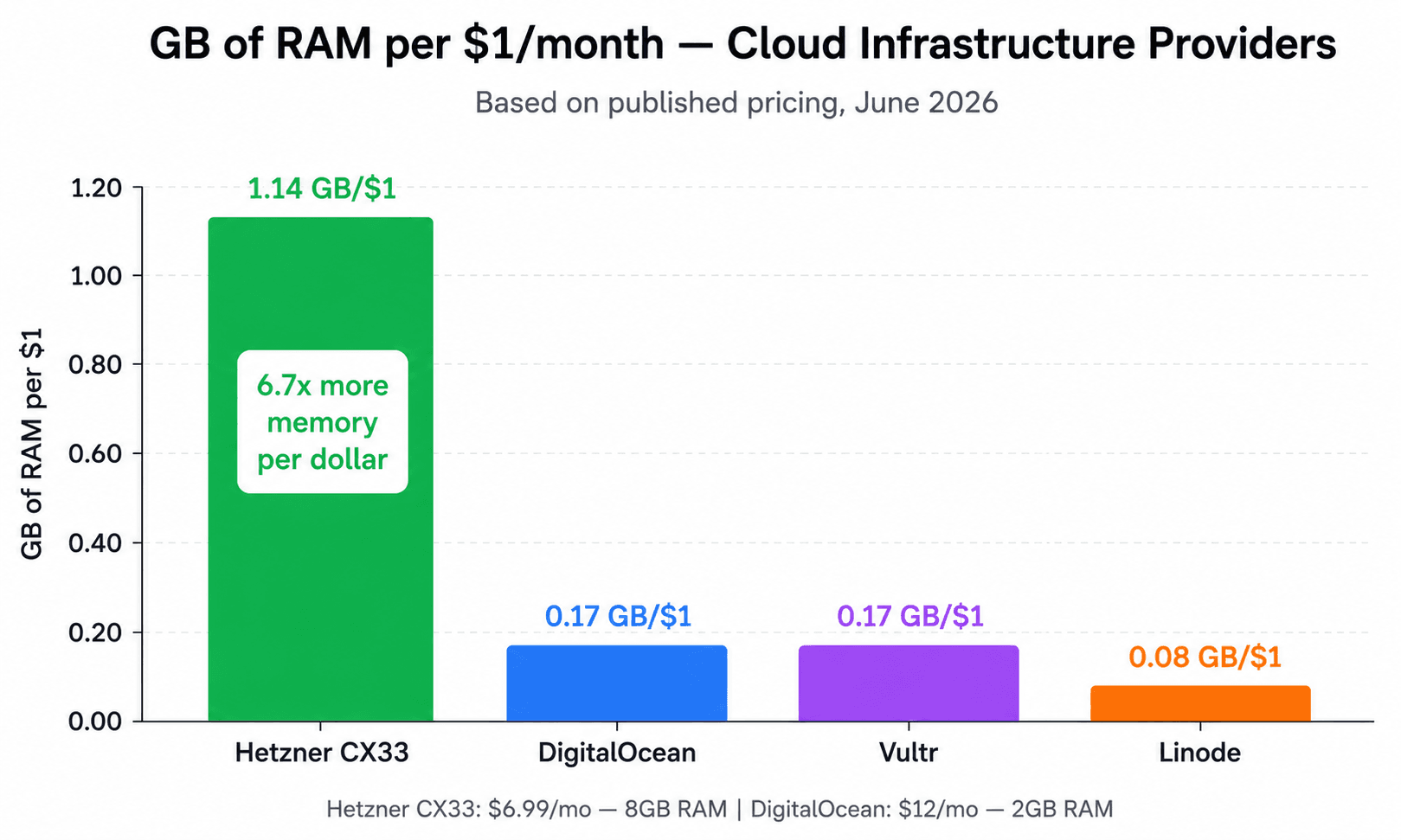
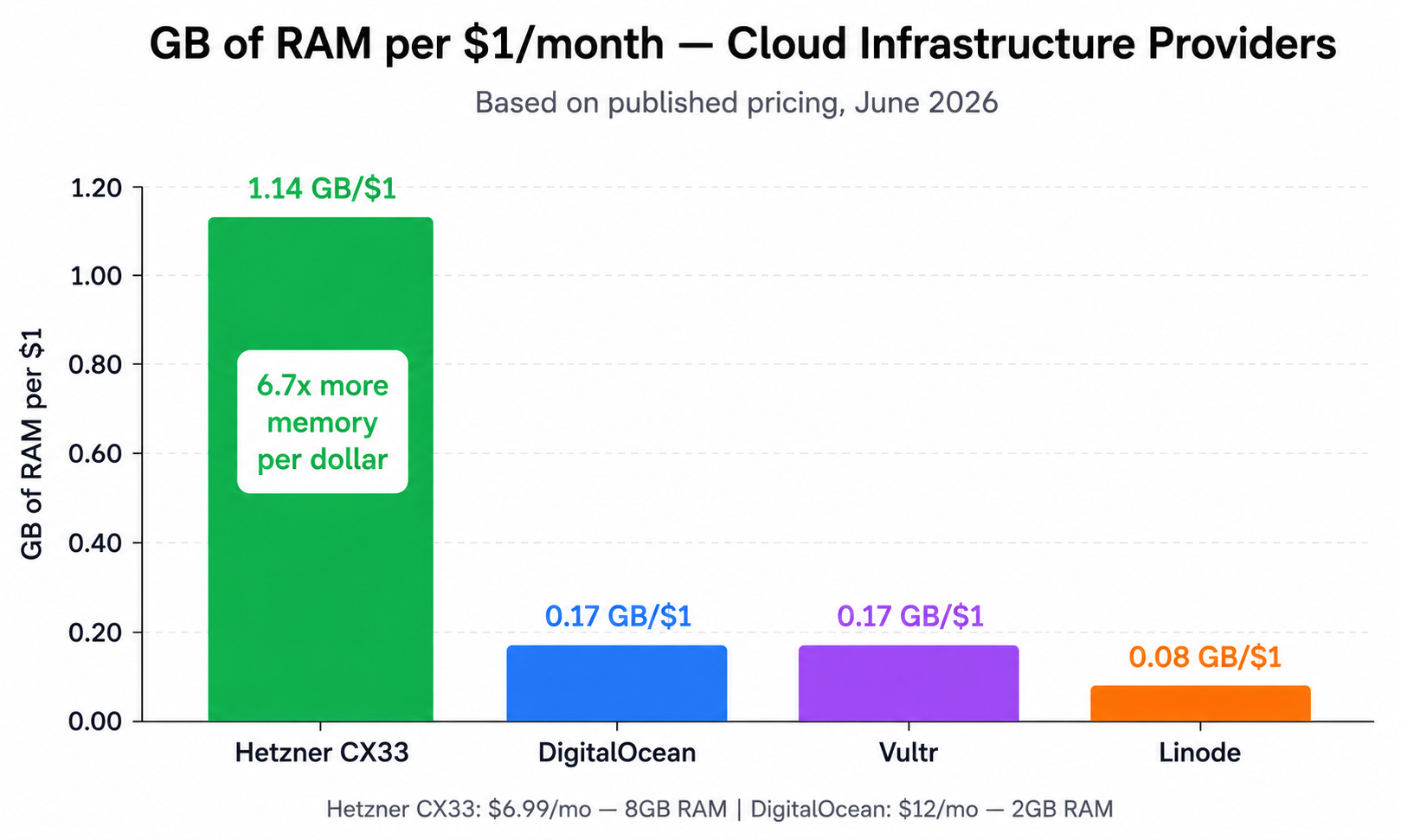
| Hetzner | CX33 | $6.99 | 8 GB | 4 shared | 80 GB SSD | 20 TB |
| Hetzner | CX23 | $4.49 | 4 GB | 2 shared | 40 GB SSD | 20 TB |
| DigitalOcean | Droplets (2GB) | $12/mo | 2 GB | 1 shared | 50 GB SSD | 2 TB |
| Vultr | Standard | $6/mo | 1 GB | 1 shared | 25 GB SSD | 1 TB |
| Linode | Nanode | $12/mo | 1 GB | 1 shared | 25 GB SSD | 1 TB |
Hetzner's price-to-specification ratio is not close. For $6.99 per month, the CX33 provides 8 GB of RAM and 80 GB of SSD storage with 20 TB of outbound traffic included. DigitalOcean charges $12 per month for 2 GB of RAM and 2 TB of traffic. That is 4x less RAM for 1.7x the price.
The traffic allowance difference is significant for content-heavy or API-heavy workloads. Hetzner includes 20 TB per month on all plans. Most competitors charge per gigabyte beyond a small included amount.
The tradeoff is datacenter geography. Hetzner's primary locations are in Germany, Finland, and the United States. For teams serving European users, this is not a limitation. For teams requiring multiple global regions with low-latency routing, DigitalOcean or Vultr offer more datacenter options.
Platform Providers: When Managed Infrastructure Makes Sense
For teams deploying web applications without dedicated DevOps capacity, platform providers reduce operational complexity. The comparison there is not about RAM per dollar but about developer time per deployment.
| Provider | Entry Paid Plan | Monthly Cost | Billing Model | Key Restriction |
|---|---|---|---|---|
| Railway | Hobby | $5 | Usage-based credits | $5 of credits included, overage billed |
| Render | Pro | $19/user | Per-user + compute | Free tier spins down after 15 min inactivity |
| Fly.io | Hobby | $5 | Usage-based | $5 credit included, then pay-as-you-go |
| Vercel | Pro | $20/user | Per-user | Commercial use blocked on free tier |
| Netlify | Personal | $9 | Per-user | 1,000 build minutes per month |
The Render free tier limitation is worth highlighting separately. Web services on the free tier spin down after 15 minutes of inactivity. On the next request, the container restarts from scratch, introducing 10 to 30 second cold starts. This makes the free tier unsuitable for any production use. The Pro tier at $19 per user per month removes this restriction.
For a direct comparison of the two most popular platforms in this category, Railway vs Render covers deployment model, pricing structure, and the scenarios where each performs better.
A Practical Scenario: Deploying a Next.js Application
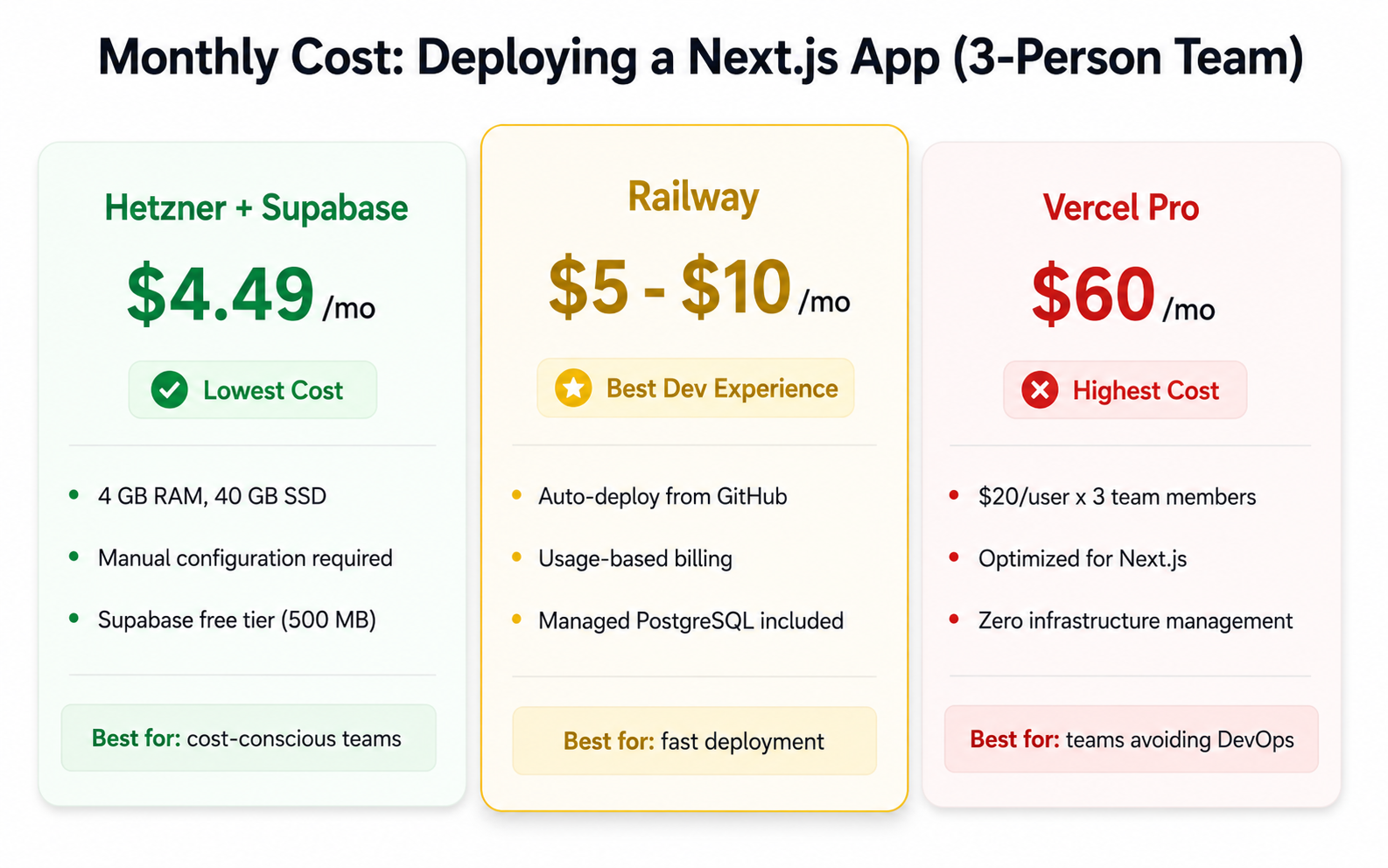
For a team deploying a Next.js frontend with a PostgreSQL database and moderate traffic (approximately 50,000 page views per month), the cost breakdown looks like this:
Using Hetzner + Supabase:
- Hetzner CX23: $4.49/mo (4 GB RAM, sufficient for a Next.js app under load)
- Supabase free tier: $0 (500 MB PostgreSQL, 2 active projects)
- Total: $4.49/mo
Using Railway:
- Railway Hobby: $5/mo (credits cover a small Node.js container)
- Railway PostgreSQL: approximately $0 to $5/mo depending on usage
- Total: $5 to $10/mo
Using Vercel:
- Vercel Pro: $20/user/mo (required for commercial use)
- Supabase free tier: $0
- Total: \(20/user/mo, or \)60/mo for a three-person team
When Hetzner Is Not the Answer
Hetzner's value is in raw compute at low cost. It is not the right choice for every use case.
Serverless functions, edge deployments, and global CDN distribution are not Hetzner's core product. Teams that need their application running in 12 geographic regions simultaneously are better served by providers with global infrastructure, even at a higher cost per compute unit.
For a detailed breakdown of how Hetzner compares to DigitalOcean specifically, Hetzner vs DigitalOcean covers infrastructure specs, regional availability, and pricing at each tier.
Data source: ComparEdge pricing database, 24 cloud hosting products tracked as of June 2026. Prices reflect published rates in USD.