
Why 70% of RAG Projects Never Reach Production in 2026
Production RAG depends on far more than the vector database. Parsing, chunking, hybrid retrieval, and evaluation usually determine answer quality.
The demo lies because the dataset is polite
A 50-document RAG demo is almost designed to succeed. The documents are clean, the questions are friendly, and the person demoing the system knows what to ask.
Production is not polite. Documents are duplicated, stale, scanned, badly formatted, cross-referenced, and full of tables. Users search by clause number, invoice ID, acronym, and half-remembered phrase. The model answers confidently even when retrieval missed the one paragraph that mattered.
The vector database is rarely the first thing that breaks. The pipeline around it usually breaks first.
ANN search in one pass

Vector search is approximate search. That word matters.
Flat search compares every vector. It gives perfect recall and bad speed once the dataset grows.
HNSW builds a graph and walks toward near neighbors. It is fast and accurate, but memory heavy. At 10 million vectors with 1536 dimensions, memory stops being a footnote.
IVF clusters the vector space and searches selected buckets. It uses less memory, but recall depends on clustering quality and how many buckets you probe.
Every production system chooses a tradeoff between recall, latency, memory, cost, and operational complexity. A missed chunk can become a wrong answer no matter how smart the LLM is.
At ComparEdge, I keep vector databases separate from general databases because the buyer is usually asking about retrieval quality, latency, metadata filtering, and RAG cost. That is a different question from "which database do we already know?"
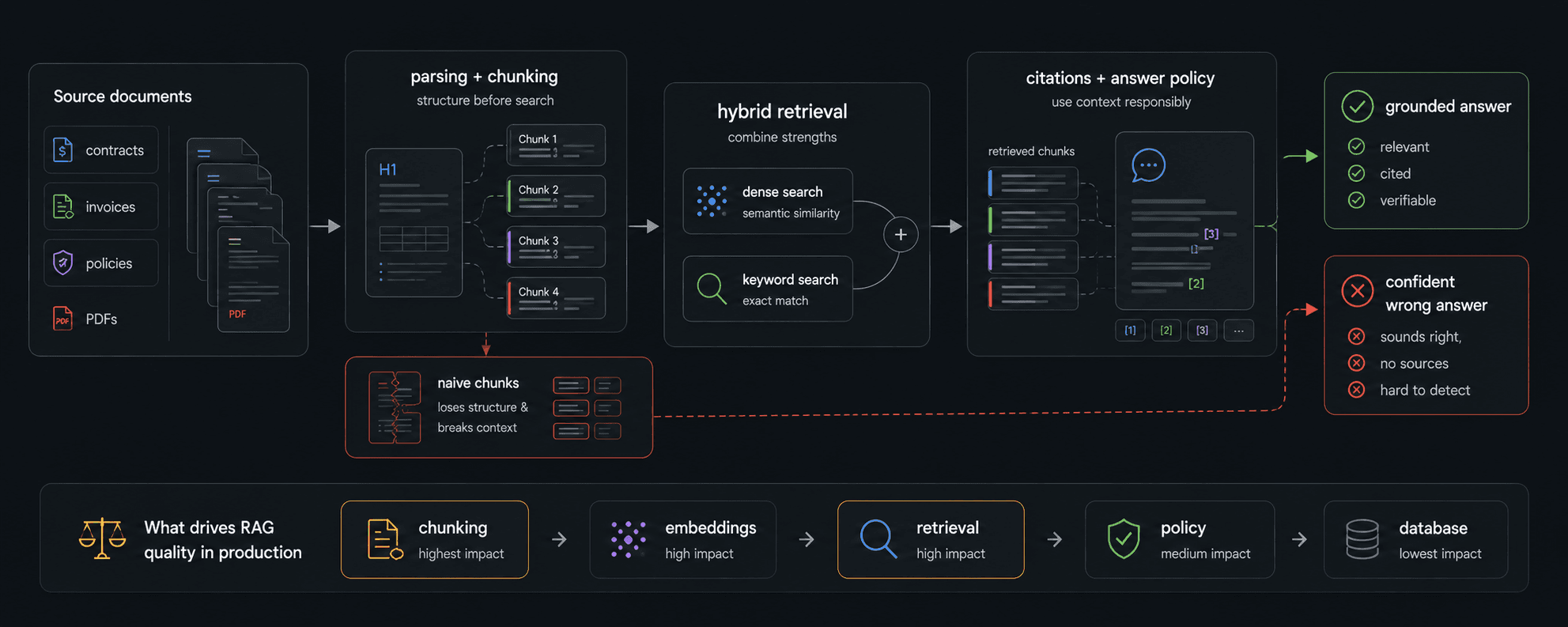
Chunking beats database selection
The default tutorial strategy, 512-token chunks with overlap, is fine for a demo. It is dangerous for contracts, policies, invoices, API docs, and anything with tables.
A legal clause may depend on a definition in section 1.2, a condition in section 4.7, and an exception in appendix B. Fixed chunking splits the relationship. The embedding sees fragments. The retriever returns a partial answer. The LLM writes it nicely. The business trusts it.
Document-aware chunking is harder. It respects headings, tables, lists, and cross-references. It takes parsing work that nobody wants to schedule. That is why teams skip it and then spend months trying to fix accuracy by swapping databases.
Wrong layer.
Hybrid search is not optional for real users
Embeddings are good at meaning. They are weak at exact identifiers.
"How do I terminate my subscription?" and "what are the cancellation terms?" are semantic matches. Dense retrieval works.
"Clause 7.3.2", "INV-2024-0847", "SOC2 Type II", and "customer_id 18492" need keyword matching. BM25 still earns its keep.
Hybrid retrieval combines dense semantic search with sparse exact matching. In many real workloads, pgvector plus PostgreSQL full-text search can beat a more expensive dense-only setup because it retrieves the exact thing the user asked for.

| Database | What it does | Complexity | Main weakness |
|---|---|---|---|
| Pinecone | Managed vector search with metadata filtering | Low | Cost at scale and dense-first defaults |
| Weaviate | Vector plus keyword hybrid search | Medium | Self-hosting can be resource-heavy |
| Qdrant | High-performance vector search and filtering | Medium | Smaller ecosystem than older tools |
| Chroma | Embedded vector store for local/prototype use | Very Low | Not built for serious horizontal scale |
| pgvector | PostgreSQL extension for vector similarity | Low if Postgres is already used | Performance ceiling at larger scale |
| MongoDB Atlas | Vector search inside a document database | Low if MongoDB is already used | Less mature ANN tuning |
When pgvector is enough
Most RAG systems do not have 100 million vectors or 10,000 queries per second. They have a few hundred thousand chunks, internal users, and a Postgres database already running.
For those teams, pgvector is often the adult choice. It avoids another vendor, keeps metadata and relational filters close, and lets the team move slowly until scale proves otherwise.
Pinecone becomes easier to justify when vectors pass the 10 million range, latency requirements get strict, QPS is high, or multi-region availability matters. Weaviate is a better conversation when hybrid search and schema flexibility are central. Qdrant fits teams that care about filtering, performance, and keeping operational control closer to the engineering team.
The expensive wrong answer
A contract assistant says sublicensing is not allowed. Sales closes the deal. Six months later, legal finds the exception in appendix C, cross-referenced from clause 12.4. The system missed it because chunking split the context and retrieval returned only the restrictive clause.
The vector database did not "fail" in isolation. The product failed: no citations strong enough to inspect, no confidence threshold, no human review for high-stakes decisions, no eval set that tested cross-reference retrieval.
RAG output needs sources, confidence behavior, and escalation paths. Otherwise it is a confident intern with a nice API.
Procurement should not compare these products as if they were the same database with different logos. Pinecone pricing needs query volume, read units, namespaces, and storage growth next to it. Weaviate pricing depends on whether the team wants Cloud, self-hosting, or hybrid deployment. Qdrant pricing should be read against managed cluster size, filtering load, and whether self-hosting is realistic.
I care about how those checks are done, because vector database cost is rarely one line item. It is ingestion, re-indexing, embedding refreshes, metadata filters, backups, replicas, and the engineering time spent proving recall did not get worse.
What actually determines RAG quality
The hierarchy I see in practice:
Chunking and parsing
Embedding model choice
Retrieval strategy, especially hybrid search
Prompting and answer policy
Database selection

If a team spends three months comparing vector databases while using naive chunking, it is optimizing the least useful part first.
Start with documents. Build evals. Measure retrieval recall. Add hybrid search. Then pick the simplest database that meets the scale you actually have.
Tools mentioned:
Pinecone - managed vector search
Weaviate - hybrid vector and keyword search
Qdrant - vector search and filtering
Chroma - embedded local vector store
pgvector - PostgreSQL vector extension
MongoDB Atlas - document database with vector search