
The Hidden Cost of "Free" SaaS Plans: A Data Analysis of 333 Products
We track pricing changes across 494 software products at ComparEdge. Of those, 333 (67%) advertise a free plan. The median cost of the first paid tier is $19 per month. The average is $47.98. That gap between median and average exists because 7% of products skip from $0 directly to $100 or more per month with no intermediate option.
This analysis examines what those free plans actually include, where the limits are set, and why those specific limits matter.
The Numbers Behind "Free"
Of the 242 products that offer both a free tier and at least one paid tier:
- 30% charge less than $10 per month for the first upgrade
- 69% charge less than $25 per month
- 7% jump immediately past $100 per month
The $47.98 average is distorted by outliers like TiDB (free tier to $1,800/mo), CAST AI (free to \(1,000/mo), and Zesty (free to \)475/mo). For the majority of products, the free-to-paid transition costs between $10 and $25 per month. That is not expensive in isolation. The issue is what triggers that transition.
The Three Limit Patterns
Across the 333 products with free plans, the restrictions cluster into three categories.
Storage and record limits are the most common. These work because they rarely block initial use. A solo developer or small team operates comfortably within the free tier for weeks or months. The limit only becomes a problem when the product becomes genuinely useful, at which point switching is painful.
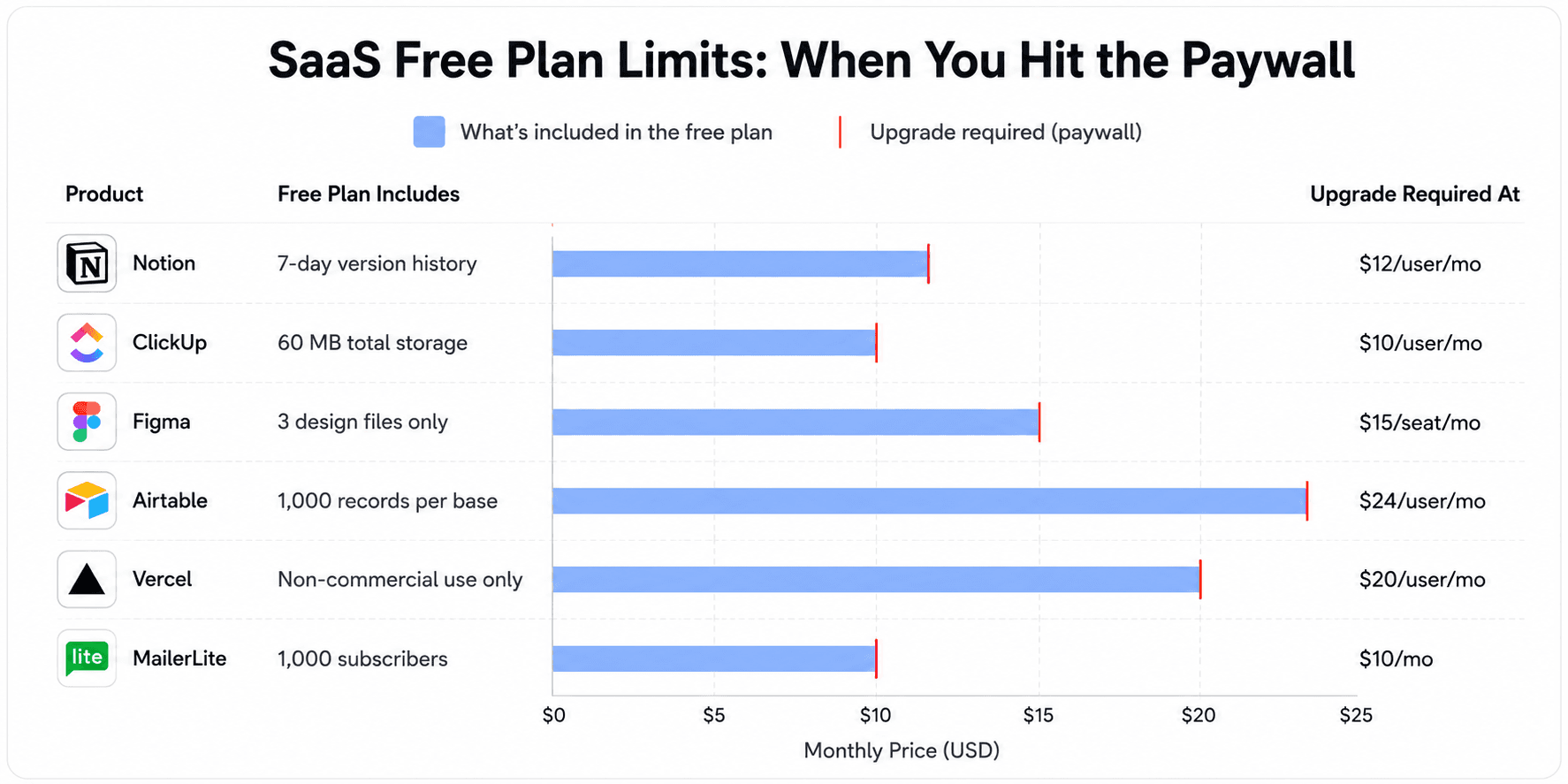
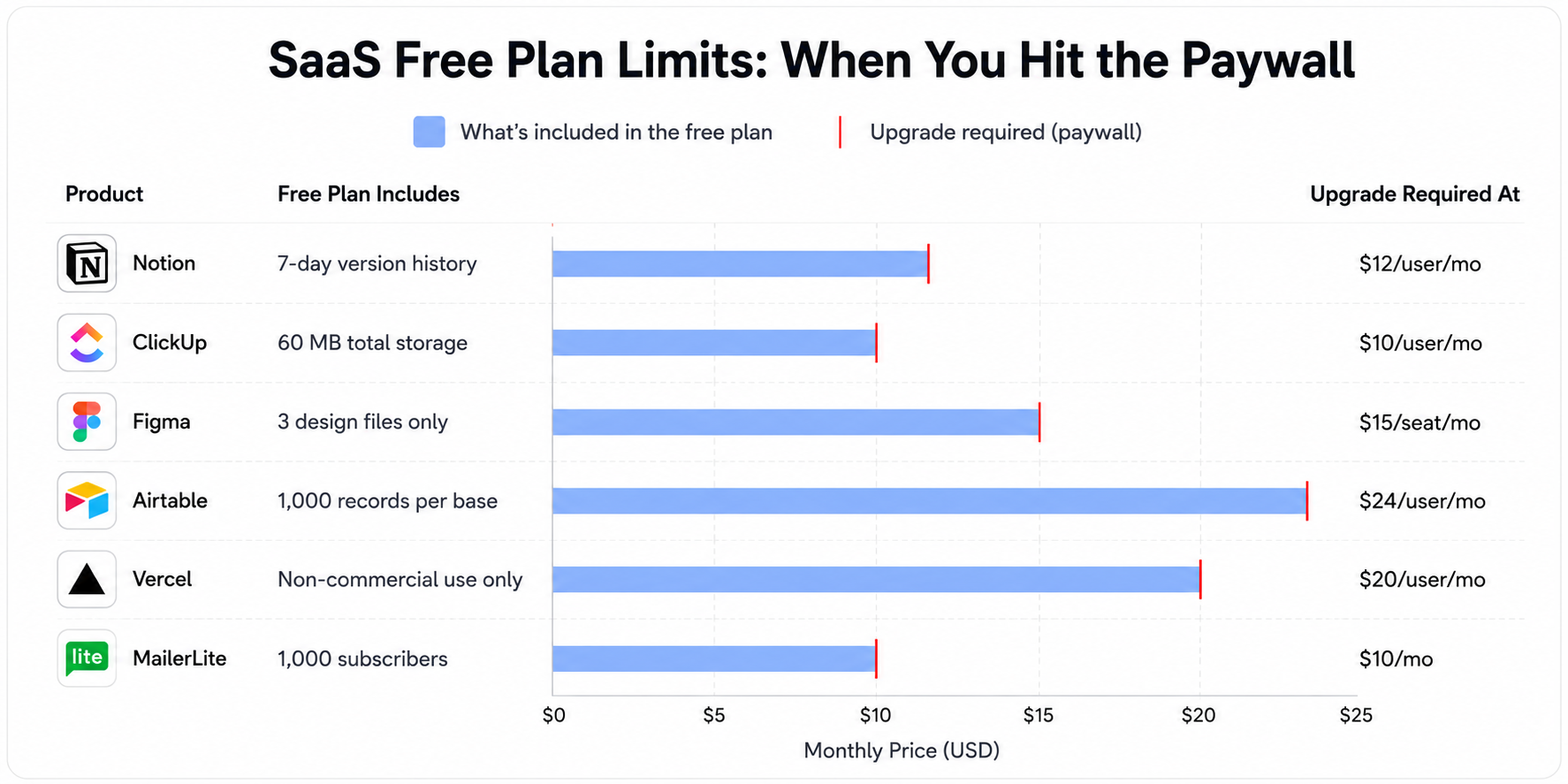
Airtable's free plan allows 1,000 records per base. For a product catalogue, a CRM, or a project tracker, 1,000 rows disappears faster than expected. The Team plan costs \(24 per user per month. A three-person team pays \)72 monthly from that point forward.
ClickUp's free tier includes 60 MB of total storage. This is not 60 MB per user or per month. It is 60 MB across the entire workspace. Any team that attaches documents, screenshots, or design files will hit this within days. The Unlimited plan costs $10 per user per month.
File and project count limits create a different kind of friction. Figma's free plan allows three design files and three FigJam files total. For a developer exploring the tool or a designer working on a single project, three files is sufficient. For any professional workflow, it is not. The Professional plan costs $15 per seat per month.
Notion restricts the free plan to 7-day version history. This limit does not block creation, but it removes the ability to audit or recover work beyond the previous week. For any team using Notion as a knowledge base or documentation system, the absence of version history is a genuine operational risk. The Plus plan costs $12 per user per month.
Commercial use and branding restrictions are the most direct conversion mechanism. Vercel's free tier states explicitly that it is for non-commercial use only. Any startup, agency, or business that deploys a product on Vercel's free tier is technically in violation of the terms of service. The Pro plan costs $20 per user per month.
Loops, an email platform, places a "Powered by Loops" footer on all emails sent from free accounts. The free tier supports 1,000 contacts and 4,000 sends per month. The first paid tier costs $49 per month.
What This Looks Like in Practice
The table below covers six widely-used products. The "real constraint" column identifies the specific limit most likely to trigger an upgrade for a small team.
| Product | Free Plan Limit | First Paid Plan | Monthly Cost | Real Constraint |
|---|---|---|---|---|
| Notion | 7-day version history, 5MB file uploads | Plus | $12/user | Collaboration history locked behind paywall |
| ClickUp | 60MB total storage | Unlimited | $10/user | Unusable for any file-heavy workflow |
| Figma | 3 design files total | Professional | $15/seat | Insufficient for any active project portfolio |
| Airtable | 1,000 records per base | Team | $24/user | Fills quickly for any data-driven use case |
| Vercel | Non-commercial use only | Pro | $20/user | Legal risk for any production deployment |
| MailerLite | 1,000 subscribers, 12,000 sends/month | Growing Business | $10/mo | Subscriber growth alone forces upgrade |
The Supabase Case: Inactivity Pauses
Supabase deserves a separate note. The free tier supports two active projects and 500MB of database storage. Those limits are reasonable for development work.
The constraint that catches developers off-guard is the inactivity rule. Free tier projects are automatically paused after 7 days of inactivity. For a developer who deploys a staging environment or an early-stage product and then steps away for a week, the database goes offline without warning. The Pro tier costs $25 per month and removes this restriction entirely.
The PostHog Counterexample
Not every free tier is designed as a conversion funnel. PostHog is the clearest exception in our dataset. Its free plan includes 1 million events per month, 5,000 session recordings, 1 million feature flag requests, and 1 year of data retention. The product team has stated publicly that the free tier is designed to be genuinely usable for small companies.
The first paid tier, Boost, costs $250 per month. But the distance between free and paid is large enough that many teams operate on the free plan for years. This approach trades short-term conversion rate for long-term trust and developer advocacy.
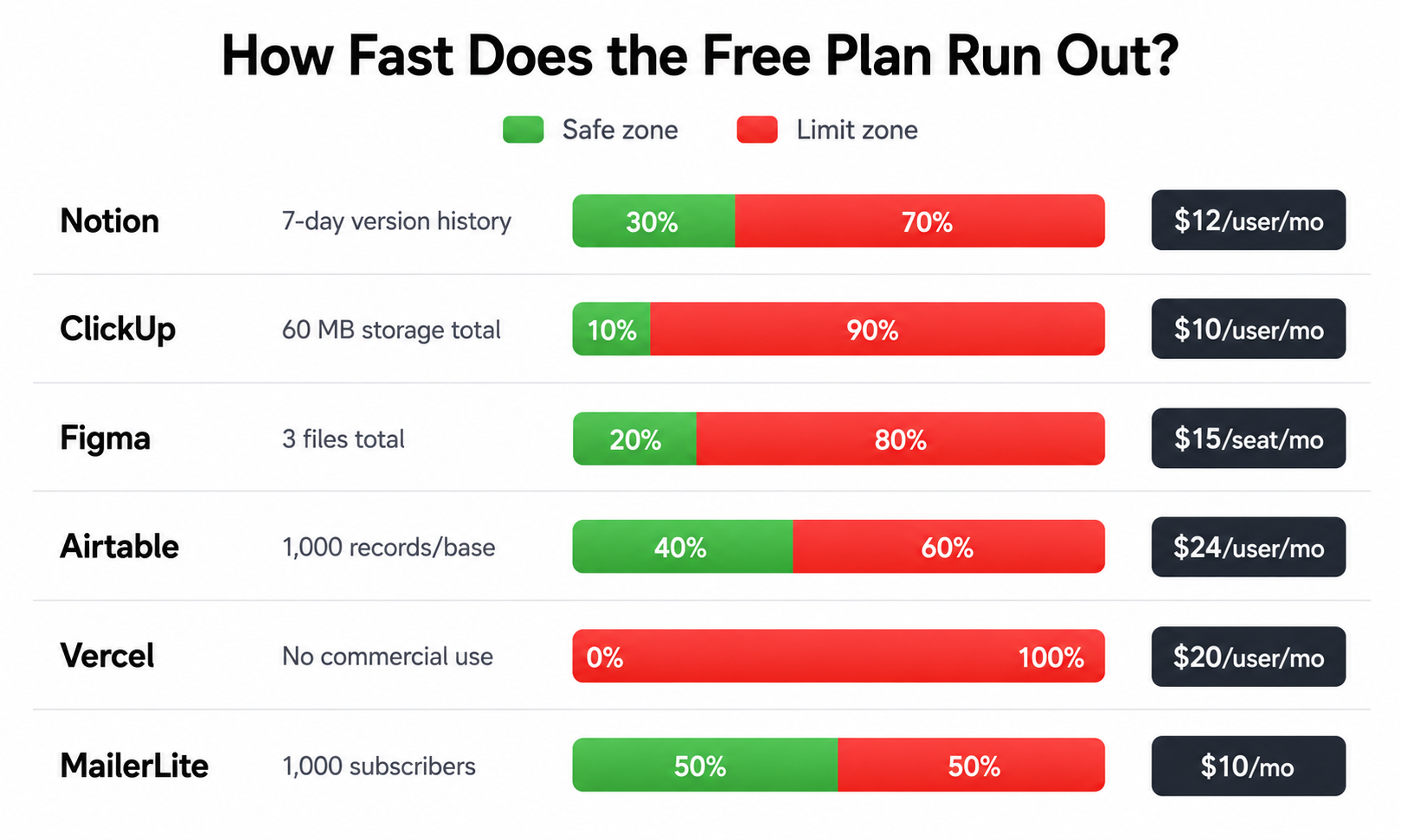
PostHog's strategy is the exception. Most products set limits that become binding within 30 to 90 days of productive use.
Practical Guidance
When evaluating a free plan, the relevant questions are:
- What specific number triggers the upgrade? Is it a record count, a seat count, a bandwidth figure?
- How long does it take a real team to reach that number?
- What is the cost per user on the first paid tier, not per account?
- Are there commercial use restrictions?
The pricing database at ComparEdge tracks these limits across 494 products and updates when vendors change their plans. For products where pricing history matters, the changelog shows when plans were modified and by how much.
Data source: ComparEdge pricing database, 494 products tracked as of June 2026. Pricing reflects published rates and is verified against vendor documentation.